
Blog
Third Party Tested Peptides: Myth-Busting and the Researcher’s Audit Guide (2026)


Did you know that 73% of peptides tested by independent laboratories show measurable differences when compared to the supplier’s original Certificate of Analysis? For researchers dedicated to precision, this statistic represents more than just a data discrepancy; it signifies a systemic risk to experimental integrity and budget allocation. You likely understand that the validity of your results depends entirely on the purity of your compounds, yet the prevalence of under-dosed or contaminated materials remains a significant obstacle. Relying on third party tested peptides is the standard protocol, but the presence of a document does not always guarantee the presence of quality.
You deserve a level of transparency that matches the rigor of your own scientific inquiry. This article promises to equip you with the analytical tools to distinguish between clever marketing and genuine verification. We’ll provide a comprehensive audit guide for Certificates of Analysis, explain the functional differences between HPLC and Mass Spectrometry, and demonstrate how to establish an uncompromised data trail for your laboratory. By the end of this guide, you’ll possess a reliable checklist to ensure every compound meets the 99% purity standard expected in 2026.
Key Takeaways
- Identify the common pitfalls of surface-level verification and why a standard Certificate of Analysis logo is often an insufficient guarantee of compound quality.
- Master the technical application of HPLC and Mass Spectrometry to confirm both the purity ratio and the specific molecular weight of your research materials.
- Evaluate the necessity of independent chain-of-custody protocols when sourcing third party tested peptides to eliminate the risk of biased in-house reporting.
- Implement a rigorous auditing checklist to verify laboratory credentials and ensure that analytical data corresponds directly to your current research batch.
- Recognize the specific synthesis lot protocols and transparency standards that define a supplier committed to technical procedural integrity and clinical authority.
The Illusion of Purity: Why ‘Lab Tested’ Often Means Nothing
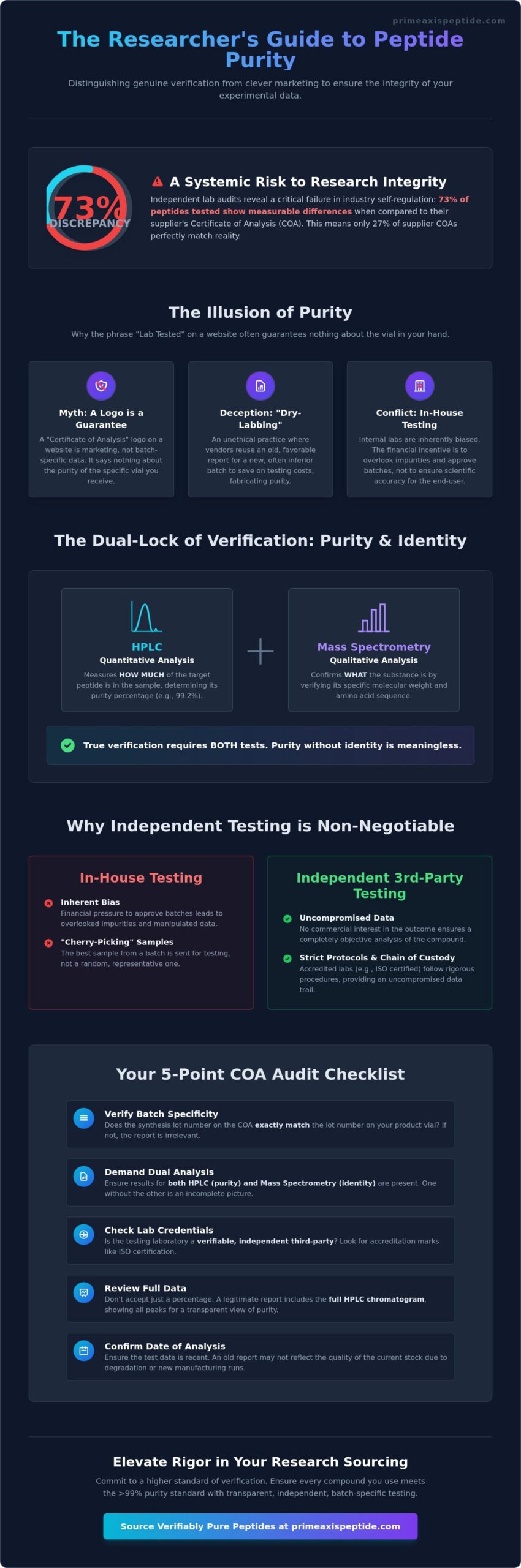
In the professional research sector, the phrase “lab tested” has been diluted into a mere marketing slogan. Authentic verification of third party tested peptides requires a complete separation between the manufacturing entity and the analytical laboratory. This independence ensures that the data isn’t manipulated to favor commercial interests. Unfortunately, many vendors exploit a lack of technical oversight by presenting a “Certificate of Analysis” logo as a substitute for actual batch-specific data. Only 27% of supplier Certificates of Analysis (COAs) exactly matched independent test results in recent audits. This discrepancy highlights a systemic failure in the industry’s self-regulation.
A logo on a landing page guarantees nothing about the specific vial in your possession. This is the first major myth of the industry. Reliable research requires a direct link between a synthesis lot and its corresponding analytical report. Claiming a 99% purity level without providing the accompanying HPLC chromatogram is scientifically invalid. Without the visual data of the peak area, a percentage is just a number on a page, easily fabricated through “dry-labbing.” This unethical practice involves a vendor reusing an old report for a completely different, often inferior, batch of peptides to save on testing costs. It’s a deceptive tactic that compromises the integrity of your entire project.
The Conflict of Interest in In-House Testing
Internal labs are inherently biased. When a company audits its own production, the incentive to overlook minor impurities or sequence errors is overwhelming. Independent, ISO-certified facilities provide the necessary friction to maintain high standards. These facilities operate under strict protocols that prevent the “cherry-picking” of superior samples. By utilizing a truly independent laboratory, researchers receive a transparent view of the compound’s profile. This avoids the curated version of reality designed to facilitate a sale rather than ensure accuracy.
Purity vs. Identity: The Critical Distinction
A critical error in compound procurement is conflating purity with identity. A sample can yield a 99% purity result on an HPLC test while containing an entirely different molecular sequence than intended. Quantitative analysis measures how much of a substance is present, but qualitative analysis confirms what that substance actually is. Every legitimate QC procedure by analytical HPLC and mass spectrometry must include both steps to be valid. Vendors often skip identity verification because it increases the cost per batch. For the researcher, this omission can lead to catastrophic experimental failure. Ensuring you receive third party tested peptides that have undergone both tests is the only way to safeguard your data integrity.
HPLC and Mass Spectrometry: The Gold Standards of Peptide Verification
Precision in biochemical research is unattainable without a dual-layered analytical approach. While many suppliers provide a single percentage to claim quality, rigorous scientific standards require both quantitative and qualitative validation. High-Performance Liquid Chromatography (HPLC) and Mass Spectrometry (MS) function as the essential pillars of this verification process. Relying on third party tested peptides that utilize only one of these methods leaves a significant margin for error. A compound might appear pure on a chromatogram while possessing an entirely incorrect amino acid sequence. To eliminate these variables, a researcher must understand how these technologies intersect to provide a complete profile of the compound.
Reading the HPLC Chromatogram
HPLC is the primary method for quantifying peptide purity via liquid separation. This technique forces the sample through a stationary phase under high pressure, allowing different molecules to elute at specific retention times. When reviewing a report, the main peak represents the target peptide. Its area relative to the total area of all peaks determines the purity percentage. Secondary peaks are not mere artifacts; they indicate the presence of synthesis byproducts, deleted sequences, or residual solvents. A critical aspect of this analysis is the evaluation of baseline noise. High levels of noise can effectively mask smaller impurity peaks, leading to an inflated purity rating. Discerning researchers look for a clean, stable baseline to ensure that the integration of the main peak is accurate and transparent.
Verifying Molecular Identity via Mass Spec
Mass Spectrometry provides the qualitative confirmation that HPLC cannot. While HPLC measures how much of a substance is present, MS confirms exactly what that substance is by measuring its mass-to-charge ratio. This process compares the measured molecular weight against the theoretical mass of the intended peptide sequence. It’s the only definitive way to ensure you aren’t inadvertently researching a structural analog or a misfolded variant. Furthermore, MS analysis identifies the presence of TFA (Trifluoroacetic acid) salts and other common additives used during the synthesis and purification stages. Without this identity check, even a 99% pure sample remains a mystery in terms of its actual chemical structure.
Adhering to established Regulatory Guidelines for Peptide Analysis ensures that the data produced is both reproducible and verifiable. These international standards dictate that both HPLC and MS are necessary to confirm that a compound is suitable for laboratory application. When you source third party tested peptides, you’re essentially purchasing the data trail as much as the physical compound. Verifying these complex analytical reports is a standard procedural requirement for those who secure their materials through Prime Axis Peptides, where technical rigor is prioritized over marketing claims. This disciplined approach to sourcing prevents the waste of research budgets on inconsistent or unverified materials.
Third-Party vs. In-House Testing: Why Independence is Non-Negotiable
True independence in biochemical verification requires a total absence of financial or operational ties between the vendor and the laboratory. When a supplier relies on in-house analysis, the results are essentially a self-audit, which lacks the adversarial nature required for scientific validity. In contrast, third party tested peptides undergo a rigorous chain of custody where samples are pulled directly from the warehouse inventory and dispatched to an external, ISO-certified facility. This process often involves “blind testing,” where the laboratory receives samples without any identifying marks that reveal the vendor’s identity. This anonymity prevents preferential treatment or unconscious bias in the reporting of impurities, ensuring the data remains objective.
Batch-to-batch variability is a persistent challenge in the synthesis of complex amino acid chains. Even with standardized production protocols, subtle changes in temperature, solvent purity, or reagent quality can alter the profile of the final product. Independent testing serves as a final gatekeeper, identifying these deviations before the compound reaches the researcher’s laboratory. This level of oversight is supported by the FDA Peptide Impurity Guidance, which emphasizes the critical nature of identifying and characterizing impurities resulting from specific manufacturing variances. Without this external check, a researcher might unknowingly introduce a variable that invalidates months of experimental work and compromises the integrity of the data.
The Economics of Quality Assurance
The financial reality of analytical chemistry is a primary reason why many low-cost vendors avoid true oversight. Standard HPLC and ESI-MS analysis bundles typically require a significant investment of several hundred dollars per sample, while more comprehensive characterization can cost thousands. When a vendor offers a vial at an extremely low price point while claiming third-party verification, the economics often fail to align. High-register quality assurance necessitates a significant reinvestment of revenue into testing protocols. For serious researchers, this investment is a prerequisite for study integrity. The cost of a failed experiment due to impure or under-dosed materials far outweighs the premium paid for third party tested peptides that come with a verifiable data trail.
Batch-Specific Transparency
Transparency is not a general claim; it is a batch-specific requirement. Some vendors provide “representative” reports, which are essentially a single test result used to justify the quality of multiple synthesis lots over several years. This practice is scientifically unsound and fails to account for the unique profile of each production run. Every unique synthesis lot must possess its own dedicated HPLC and MS data. A reliable provider ensures that the lot number on the physical vial corresponds directly to a specific, verifiable laboratory report. This direct linkage allows researchers to audit the specific material they are using, ensuring that the 99% purity standard is met for every individual purchase rather than just a theoretical average based on a single “gold” batch.
How to Audit a Certificate of Analysis (COA): A Researcher’s Checklist
The analytical audit of a Certificate of Analysis (COA) is the final safeguard against experimental contamination. While many vendors provide these documents as a courtesy, a disciplined researcher treats them as primary evidence that must be scrutinized for empirical validity. This systematic process transforms a passive purchase into an active verification of third party tested peptides. Relying on the visual presence of a report is insufficient; you must verify its provenance and technical accuracy through a structured checklist.
- Step 1: Laboratory Authentication. Begin by verifying the laboratory’s credentials. Legitimate facilities provide physical addresses and direct contact information. If the facility lacks a professional digital presence or is located in a region known for lax oversight, the data’s reliability is compromised.
- Step 2: Temporal Alignment. Cross-reference the analysis date with your purchase date. A report issued several months or years prior to your acquisition suggests the vendor is recycling data from previous synthesis lots. This practice violates the principle of batch-specific transparency discussed in previous sections.
- Step 3: Peak Integration Analysis. Examine the HPLC chromatogram for signs of manual “smoothing.” In an authentic report, the baseline should show natural electronic noise. Perfectly flat lines or abrupt, unnatural curves often indicate that a technician has manually adjusted the integration parameters to hide impurity peaks.
- Step 4: Mass Correlation. Compare the theoretical molecular weight of the peptide against the observed mass. For instance, when sourcing high-purity Tirzepatide, the measured mass must align exactly with the known molecular signature of that specific sequence. Even a minor deviation suggests a structural error or the presence of an analog.
- Step 5: Direct Verification. The most effective way to prevent fraud is to contact the testing facility directly. Provide them with the report number and the lot ID to confirm they actually conducted the analysis and that the results haven’t been altered.
Common Red Flags in Forged Reports
Mismatched fonts, pixelated logos, or “cut-and-paste” artifacts are clear indicators of document tampering. Redacted laboratory names or technician signatures should be viewed with extreme suspicion. A missing “Analysis Date” is perhaps the most frequent indicator of a recycled report. These reports are often designed to mislead the researcher about the material’s age and stability. When you encounter third party tested peptides with obscured data fields, it is safer to assume the integrity of the compound has been compromised.
Digital Verification and QR Codes
The industry is shifting toward blockchain-secured reports and QR-verified documentation to combat sophisticated fraud. Leading laboratories now provide online portals where a specific report number can be entered to retrieve the original, untampered PDF directly from the source. This digital trail eliminates the possibility of vendor-side alterations. A valid COA must be verifiable through the third-party lab’s own database to be considered a reliable instrument of quality control.
Prime Axis Peptides: Elevating Rigor in Research Compound Sourcing
Prime Axis Peptides operates at the apex of compound distribution, where technical rigor replaces the standard marketing narratives found in the broader market. We understand that the validity of your research depends on more than just a label. It requires a verifiable, uncompromised data trail. Our commitment to procedural integrity ensures that we provide third party tested peptides that meet the highest possible analytical benchmarks. While other vendors might rely on representative testing, we maintain a strict policy of batch-specific verification for every synthesis lot we distribute.
Bridging the gap between industrial synthesis and elite laboratory standards is our primary objective. We do not view analytical testing as a bureaucratic hurdle or a marketing expense. Instead, we treat it as the foundation of our operational philosophy. Every compound in our inventory, from Tirzepatide 10mg to Retatrutide 10mg, is accompanied by exhaustive documentation that allows you to verify its purity and identity before you begin your work. This level of oversight is a non-negotiable requirement for maintaining the security of your research data.
Our Analytical Philosophy
Precision is our priority. We intentionally avoid the high-pressure urgency of retail appeals to focus on the clinical authority required by modern science. Our third-party laboratory partners are selected through a meticulous vetting process that evaluates their adherence to ISO standards and their capability to provide unbiased, adversarial data. This disciplined approach is essential for maintaining the 99% purity threshold that defined the industry shift in 2026. We prioritize the science of the compound over the aesthetics of the branding.
We actively support researchers in evaluating BPC-157 purity standards and other complex sequences. By providing comprehensive HPLC and Mass Spectrometry reports, we empower you to perform the audit steps outlined in this guide with total confidence. Our transparency is not a slogan; it is a procedural requirement that ensures the integrity of your research compounds remains unassailable. This ensures that every vial of BPC-157 5mg or TB-500 5mg you receive has been validated through rigorous quantitative and qualitative analysis.
Secure Your Research Integrity
Maintaining a secure data trail is vital for long-term study success. We ensure that the latest Certificates of Analysis for our current inventory are readily accessible to our clients. This allows for the cross-referencing of lot numbers and laboratory databases as a standard part of your procurement process. As a disciplined leader in the research chemical space, Prime Axis Peptides provides the steady reassurance that comes from exacting procedural standards. We eliminate the ambiguity that often plagues the acquisition of research materials.
You should never have to compromise your experimental results due to inconsistent materials or obscured data. Our role is to provide the reliable pillar of quality that serious researchers demand. We invite you to Explore our catalog of third-party verified research peptides to secure the compounds necessary for your next project. By choosing third party tested peptides from a source that prioritizes technical oversight, you protect your budget and your scientific reputation. Excellence in research begins with excellence in sourcing.
Securing the Future of Research Integrity through Analytical Rigor
The pursuit of scientific advancement requires an uncompromising dedication to the quality of your research materials. As this guide has demonstrated, the presence of a laboratory logo is no substitute for a verifiable, batch-specific data trail. By implementing a rigorous audit of every Certificate of Analysis and demanding both HPLC and Mass Spectrometry validation, you eliminate the variables that lead to inconsistent results. Sourcing third party tested peptides is not merely a logistical step; it’s a fundamental commitment to the credibility of your experimental findings.
Prime Axis Peptides remains dedicated to providing the technical oversight and clinical-grade purity standards necessary for elite research environments. Our protocol includes independent ISO-certified lab verification and accessible, batch-specific HPLC/MS reports for every compound in our catalog. This disciplined approach ensures that your focus remains on the science rather than the integrity of your compounds. We invite you to utilize these analytical tools to elevate the standards of your own laboratory practice.
Secure Your Research Integrity: Shop Third-Party Verified Peptides. We’re ready to support your next breakthrough with the precision and transparency your work demands.
Frequently Asked Questions
What is a ‘good’ purity percentage for research peptides?
A purity level of 99% or higher is the current benchmark for technical excellence in 2026. While 98% was previously the accepted minimum, advancements in synthesis and purification have raised the standard for rigorous research. This higher threshold ensures that experimental variables are minimized. If a report shows a value below 99%, it indicates a lack of exacting oversight during the production or purification stages.
Can I trust a COA if the laboratory name is redacted?
Redacted laboratory names on a Certificate of Analysis are a significant red flag that invalidates the report’s credibility. Transparency is non-negotiable in scientific research, and an obscured lab identity prevents you from performing the necessary due diligence. Without a named facility, you cannot verify the report’s authenticity or the laboratory’s certification status. You should always insist on third party tested peptides that provide full, unedited documentation.
How do I know if a peptide report is for the specific batch I bought?
You must cross-reference the batch or lot number printed on your vial with the identification number listed on the analytical report. Every unique synthesis run produces a distinct chemical profile that requires its own validation. If the vendor provides a generic or “representative” report without a matching lot number, the data doesn’t apply to your specific material. Maintaining this direct link is essential for establishing an uncompromised data trail.
What is the difference between HPLC and Mass Spectrometry?
High-Performance Liquid Chromatography (HPLC) quantifies the purity of a sample by separating its components, while Mass Spectrometry (MS) confirms the chemical identity by measuring molecular weight. HPLC tells you how much of the target substance is present relative to impurities. MS ensures the substance is actually the correct peptide sequence. Both tests are required to provide a complete and authoritative profile of third party tested peptides.
Is in-house testing ever acceptable for research purposes?
In-house testing is insufficient for high-level research because it lacks the adversarial oversight of an independent entity. Internal results are inherently biased toward positive outcomes to facilitate commercial sales. Independent verification by an external facility is the only way to ensure that the data is objective and free from institutional conflicts of interest. Relying on self-audited reports compromises the procedural integrity of your study.
How can I verify a report with the third-party lab directly?
Verification is achieved by contacting the laboratory listed on the report and providing the unique report ID and lot number. Most reputable facilities now offer secure online portals where you can enter these credentials to retrieve the original document. If a lab refuses to confirm a report or if the vendor cannot provide an ID that matches the lab’s database, the document is likely forged or recycled.
Why do some peptides show multiple peaks on an HPLC report?
Secondary peaks on an HPLC chromatogram represent impurities such as synthesis byproducts, deleted sequences, or residual solvents used during purification. The main peak represents the target peptide, and the area of these smaller peaks is subtracted to determine the final purity percentage. A report with significant baseline noise or multiple large secondary peaks indicates a compound that doesn’t meet elite laboratory standards for precision and craftsmanship.
Does third-party testing guarantee that a peptide is sterile?
Standard third-party testing via HPLC and Mass Spectrometry evaluates purity and identity but does not inherently confirm sterility. Verification of sterility or the absence of endotoxins requires separate specialized testing protocols that are distinct from chemical analysis. Researchers should confirm whether their supplier performs these additional safety checks in addition to the standard analytical procedures required for chemical characterization.