

Blog
TB-500 Research Peptide: A Comprehensive Analysis of Molecular Mechanism and Laboratory Application


The technical significance of the TB-500 research peptide is defined by its low molecular weight and its unique capacity to sequester G-actin, a mechanism that facilitates cellular mobility in ways distinct from larger protein structures. You likely recognize that the absence of standardized reconstitution protocols and the ambiguity surrounding high-purity sourcing often compromise the integrity of laboratory data. Maintaining procedural excellence requires a disciplined approach to biochemical stability and a deep understanding of how synthetic fragments interact within controlled environments.
This analysis provides an authoritative exploration of the biochemical properties of TB-500, offering clear protocols for laboratory preparation and a thorough verification of quality standards for research reagents. We’ll examine the specific molecular mechanisms that differentiate this synthetic fragment from endogenous Thymosin Beta-4 while addressing the critical regulatory landscape, including the July 2026 PCAC review and current FDA classifications. By establishing a rigorous framework for application, this guide ensures your research remains grounded in technical precision and industry-leading benchmarks. You’ll gain the clarity needed to navigate complex biochemical interactions with professional confidence and clinical authority.
Key Takeaways
- Define the biochemical relationship between the TB-500 research peptide and endogenous Thymosin Beta-4 to establish a foundation for precise experimental modeling.
- Analyze the molecular mechanism of G-actin sequestration and its specific impact on cellular mobility and angiogenic processes within laboratory environments.
- Implement standardized reconstitution protocols that utilize precise diluent calculations and aseptic techniques to ensure the structural integrity of the peptide.
- Evaluate sophisticated analytical techniques, such as HPLC and Mass Spectrometry, to verify reagent purity and confirm the absence of molecular contaminants.
Understanding the Molecular Architecture of TB-500
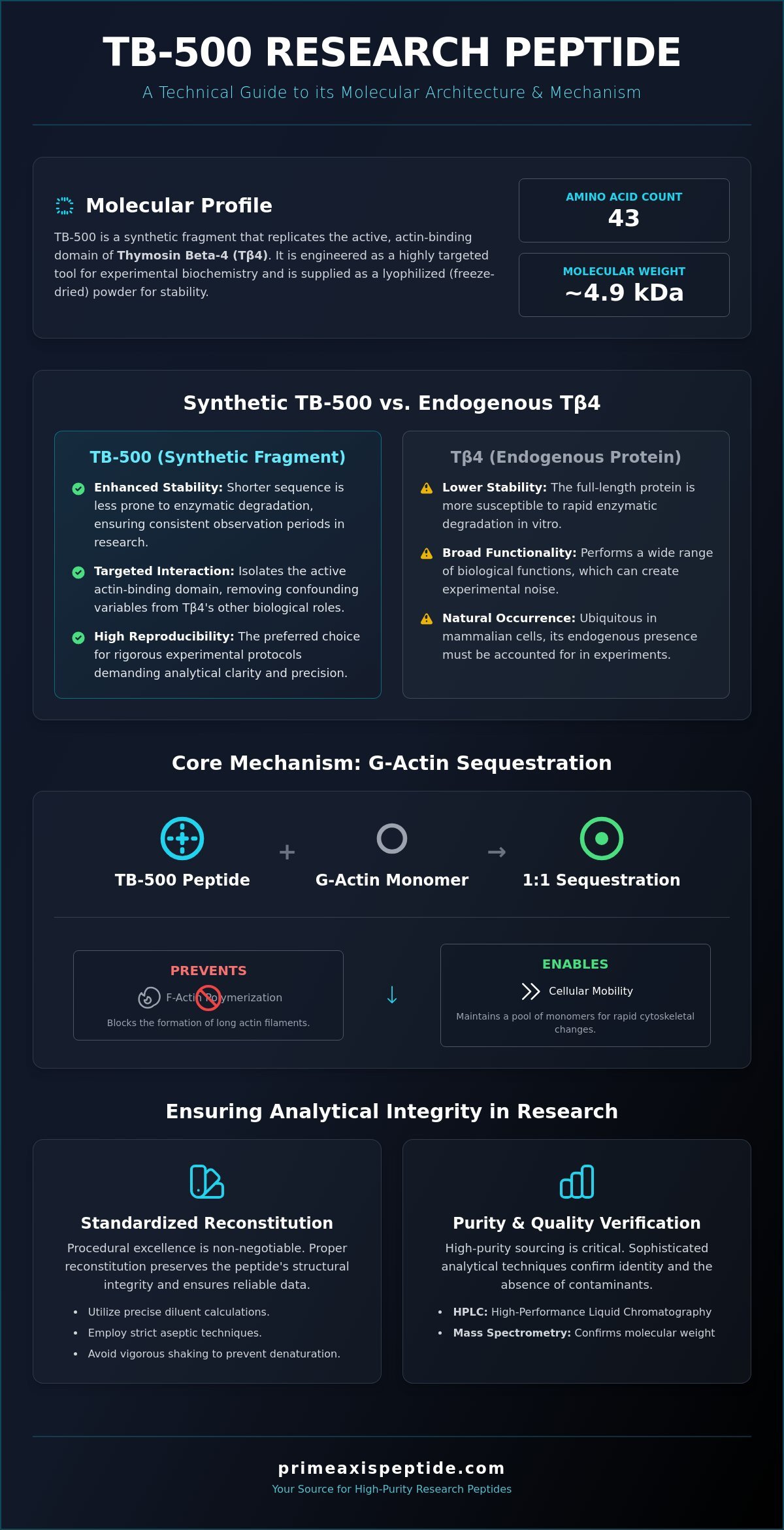
The TB-500 research peptide is a synthetic 43-amino acid fragment that replicates the active domain of Thymosin Beta-4 (Tβ4), a ubiquitous protein found in nearly all mammalian cells. Scientific interest in this molecule dates back to the early 1980s, when researchers first isolated thymic hormones to understand their influence on cellular migration and tissue repair. While endogenous Tβ4 is a full-length protein, TB-500 is synthesized to isolate specific sequences, making it a highly targeted tool for experimental biochemistry. It’s critical to distinguish these research-grade lyophilized powders from clinical medications; they’re produced under strict laboratory standards specifically for in vitro and animal model investigations to ensure procedural integrity.
A foundational TB-500 Overview clarifies that while the terms are often used interchangeably in laboratory settings, TB-500 specifically denotes the synthetic fragment designed for experimental consistency. This precision in nomenclature is vital for maintaining the technical rigor required in modern industrial and academic research environments.
Chemical Structure and Properties
The molecular sequence of TB-500 is defined as: Ac-Ser-Asp-Lys-Pro-Asp-Met-Ala-Glu-Ile-Glu-Lys-Phe-Asp-Lys-Ser-Lys-Leu-Lys-Lys-Thr-Glu-Thr-Gln-Glu-Lys-Asn-Pro-Leu-Pro-Ser-Lys-Glu-Thr-Ile-Glu-Gln-Glu-Lys-Gln-Ala-Gly-Glu-Ser. This specific arrangement results in a low molecular weight of approximately 4.9 kDa. This small size is a vital characteristic for laboratory application, as it enhances cellular permeability and allows the peptide to diffuse through tissues more efficiently than larger, more complex proteins. In its stable form, the TB-500 research peptide exists as a lyophilized (freeze-dried) white powder. This state preserves the structural integrity of the amino acid chain during transport and storage, ensuring that the biochemical properties remain intact until the moment of reconstitution in a controlled setting.
Synthetic vs. Endogenous Thymosin Beta-4
The primary distinction between the synthetic fragment and the endogenous protein lies in stability and focus. Endogenous Tβ4 performs a wide range of biological functions, but the synthetic fragment is engineered to mimic only the most active domain responsible for actin binding. This truncated chain offers several advantages in a laboratory setting:
- Enhanced Stability: The shorter sequence is less prone to rapid enzymatic degradation compared to the full-length protein, allowing for more consistent observation periods.
- Nomenclature Precision: Using the specific synthetic designation allows researchers to differentiate their reagents from naturally occurring isolates.
- Targeted Interaction: By focusing on the active sequence, researchers can more accurately measure the effects of actin sequestration without the confounding variables of the full protein’s other biological roles.
These factors make the synthetic fragment the preferred choice for rigorous experimental protocols that demand high levels of reproducibility and analytical clarity. It’s an elite tool for those who prioritize exacting standards in their investigative processes.
The Biochemical Mechanism: Actin Sequestration and Angiogenesis
The primary biological utility of the TB-500 research peptide lies in its role as a major G-actin (globular actin) sequestering molecule. In a cellular environment, actin exists in a delicate equilibrium between its monomeric G-actin form and its polymerized filamentous F-actin form. By binding to G-actin monomers in a 1:1 ratio, TB-500 effectively prevents their polymerization into F-actin. This sequestration maintains a pool of available monomers, which is essential for the rapid cytoskeletal reorganization required during cellular migration and chemotaxis. It’s this specific molecular interaction that allows cells to shift their internal structure rapidly in response to external signals.
Beyond structural regulation, this peptide induces the upregulation of matrix metalloproteinases (MMPs). These enzymes are responsible for degrading extracellular matrix components, a necessary precursor to tissue remodeling. This dual action-providing the building blocks for movement while clearing the physical path-positions the TB-500 research peptide as a critical reagent in studies focused on tissue regeneration and morphological changes. By facilitating the breakdown of the basement membrane, the peptide enables cells to traverse through tissue barriers more effectively.
Cellular Mobility and Wound Healing Pathways
Research models demonstrate that TB-500 facilitates the migration of keratinocytes and endothelial cells, which are pivotal for structural restoration. In vitro studies indicate that this migration significantly influences the rate of re-epithelialization, the process by which a denuded surface is recovered with new epithelial cells. Technical analysis of Thymosin β4 Function and Application suggests that these effects are mediated through complex interactions with the Notch signaling pathway. This pathway governs vascular development and cell-fate determination, making it a focal point for researchers investigating vascular integrity and repair mechanisms. When cells don’t have to fight against rigid actin structures, their ability to close gaps in a culture medium is noticeably enhanced.
Angiogenic Potential in Tissue Repair
Angiogenesis, the formation of new blood vessels from pre-existing vasculature, is another cornerstone of the peptide’s biochemical profile. Laboratory observations reveal that TB-500 stimulates the expression of Vascular Endothelial Growth Factor (VEGF), a primary signal protein that triggers the growth of new capillaries. This angiogenic drive is often accompanied by modulated collagen deposition and a reduction in inflammatory markers within the research model. For laboratories requiring high-purity reagents to investigate these pathways, sourcing a verified TB-500 5mg vial ensures that experimental outcomes aren’t skewed by molecular impurities. This commitment to reagent integrity is vital when measuring subtle shifts in VEGF expression or collagen alignment across multiple experimental cycles.
Current Frontiers in TB-500 Laboratory Research
The investigative scope of the TB-500 research peptide has expanded significantly beyond its foundational role in actin sequestration. Current laboratory models prioritize its application in musculoskeletal injury studies, specifically targeting the repair of tendons, ligaments, and skeletal muscle tissue. These studies often observe how the peptide facilitates the migration of progenitor cells to the site of damage, a process that’s critical for structural restoration. Beyond the musculoskeletal system, researchers are exploring cardioprotective properties in ischemic models. Preliminary data suggest that the peptide’s angiogenic influence may assist in the preservation of myocardial tissue following restricted blood flow events by promoting capillary formation.
Neurological research represents another advancing frontier. Investigators are examining the peptide’s impact on axonal growth and remyelination in central nervous system models. By influencing the microenvironment around damaged nerves, the TB-500 research peptide provides a technical framework for studying neuro-regenerative pathways. These multifaceted applications highlight the compound’s versatility as a reagent for complex biological systems, especially when researchers seek to understand how low molecular weight fragments penetrate the blood-brain barrier in controlled environments.
Comparative Analysis: TB-500 vs. BPC-157
A frequent area of inquiry involves the synergistic potential of pairing TB-500 with other regenerative compounds. While both are used in tissue repair models, their molecular pathways are distinct. TB-500 exerts a systemic influence through its low molecular weight and actin-binding capabilities, allowing it to circulate and affect distant tissues effectively. In contrast, BPC-157 is often characterized by its localized action and its ability to modulate nitric oxide pathways and growth factor expression. For researchers conducting comparative studies, you can Buy BPC-157 research peptide to evaluate how these two mechanisms interact. Combining the systemic cellular mobility of TB-500 with the localized angiogenic support of BPC-157 offers a comprehensive model for investigating accelerated tissue restoration.
Emerging Studies in Anti-Inflammatory Research
Recent laboratory investigations focus on the peptide’s ability to regulate T-cell activity and modulate cytokine production. This anti-inflammatory profile is particularly relevant in studies involving oxidative stress markers. By attenuating the production of pro-inflammatory cytokines, the peptide creates a more favorable environment for cellular repair in laboratory subjects. Future directions in experimental biochemistry will likely delve deeper into these pathways to determine the compound’s efficacy in managing chronic inflammatory responses within animal models. This disciplined approach to research ensures that every molecular interaction is documented with the precision and technical rigor required by industry-leading benchmarks.
Standardized Experimental Protocols for Peptide Reconstitution
Ensuring the analytical integrity of the TB-500 research peptide begins with a meticulously controlled reconstitution process. In a laboratory environment, the goal is to transition the lyophilized powder into a stable liquid state without compromising the delicate amino acid chain. This requires an aseptic workspace, typically a laminar flow hood or a thoroughly disinfected benchtop, to prevent the introduction of microbial contaminants. Procedural excellence in these early stages is the foundation upon which reliable data is built. Contamination or mechanical stress can lead to peptide degradation, rendering the compound inert for analytical purposes.
The choice of diluent is equally critical. High-quality bacteriostatic water, containing 0.9% benzyl alcohol, is the industry standard because it effectively inhibits the growth of most bacteria. For researchers requiring consistent results, utilizing a verified Bacteriostatic Water 30ml solution ensures that the peptide remains viable throughout the duration of the study. Calculating the volume of this diluent is a matter of mathematical precision. For instance, adding 2.0 mL of bacteriostatic water to a 5 mg vial of TB-500 yields a concentration of 2.5 mg/mL. Documenting these values with absolute accuracy is essential for reproducible research.
Step-by-Step Reconstitution Guide
A disciplined approach to the physical act of reconstitution prevents mechanical degradation of the peptide. Start by swabbing the vial stopper and the diluent source with 70% isopropyl alcohol; allow them to air dry completely. When introducing the diluent, angle the needle so the liquid flows slowly along the side of the glass vial rather than directly onto the lyophilized cake. This slow-drip method minimizes the formation of air bubbles and prevents structural shear. Once the diluent is added, don’t shake the vial. Instead, gently swirl the container or allow it to sit undisturbed until the powder has dissolved naturally into a clear, colorless solution. Final documentation should include the date, time, and specific concentration (mg/mL) to maintain a complete audit trail.
Storage and Stability Parameters
Reconstituted peptides are significantly more sensitive to environmental factors than their lyophilized counterparts. While the TB-500 research peptide is relatively stable in its freeze-dried state at room temperature for short periods, it should be stored at -20°C for long-term preservation. Once reconstituted, the solution must be kept at 2°C to 8°C. Protecting the vial from UV light and thermal fluctuations is paramount, as light exposure can catalyze oxidation. Researchers should also account for half-life considerations; most prepared solutions maintain peak stability for approximately 8 to 14 days under optimal refrigeration. Proper storage isn’t a mere recommendation; it’s a technical requirement for those who demand the highest possible standards in experimental biochemistry.
Ensuring Analytical Integrity in Research Peptide Sourcing
The reliability of experimental data depends entirely on the analytical integrity of the TB-500 research peptide used within the study. High-Performance Liquid Chromatography (HPLC) serves as the definitive method for purity verification, utilizing a stationary phase to separate and quantify individual components within a sample. This process ensures that the compound meets the 99% purity threshold required for high-tier industrial research. Complementing this, Mass Spectrometry (MS) provides an essential confirmation of molecular weight. By measuring the mass-to-charge ratio of the ionized peptide, researchers can verify that the synthesized sequence matches the 4.9 kDa structure of the target molecule. These technical benchmarks are the only way to guarantee that the reagent will perform as expected in a controlled environment.
Prime Axis Peptides maintains a commitment to these exacting standards, prioritizing procedural integrity over casual market appeals. Third-party laboratory testing is a non-negotiable requirement for any research-grade material; it provides an objective audit trail that internal testing cannot replicate. This level of oversight guarantees that every reagent performs predictably under rigorous laboratory conditions. When researchers use verified compounds, they eliminate the variables associated with impurities, allowing for a clearer focus on the biochemical interactions at hand.
Identifying Reputable Research Sources
Evaluating a supplier requires a meticulous review of their Certificate of Analysis (COA) documentation. A transparent COA doesn’t just state a purity percentage; it provides the raw HPLC and MS data for independent verification. Additionally, the significance of cold chain shipping shouldn’t be overlooked. While the lyophilized state offers some protection, maintaining a stable temperature during transit is vital for long-term peptide stability. You should avoid suppliers that offer medical advice or prescriptions, as these practices are inconsistent with the specialized, technical environment of advanced biochemical research. A reputable source remains focused on the science and mechanics of the industry, providing a reliable pillar for those who demand the highest possible standards.
Conclusion: The Future of TB-500 in Scientific Discovery
The unique G-actin sequestration mechanism of the TB-500 research peptide continues to position it as a cornerstone of regenerative biochemistry. As we’ve explored, its ability to facilitate cellular mobility through cytoskeletal regulation offers a sophisticated framework for understanding tissue repair and angiogenic signaling. Achieving valid experimental outcomes requires a steadfast dedication to rigorous laboratory standards and the use of uncompromising reagents. To ensure the precision of your next study, Explore high-purity TB-500 5mg for your laboratory research and maintain the technical rigor your work demands. The path to scientific innovation is paved with meticulous expert oversight and elite production capabilities.
Advancing Experimental Standards in Peptide Research
The progression of regenerative biochemistry depends on the precise application of compounds like the TB-500 research peptide. We’ve established how its unique 43-amino acid structure facilitates cellular mobility through G-actin sequestration and why standardized reconstitution protocols are vital for molecular stability. These technical foundations ensure that experimental outcomes are both reproducible and analytically sound. It’s clear that the intersection of innovative research and uncompromising reagent quality defines the future of the field.
Maintaining this level of technical rigor requires access to materials that meet the highest industry benchmarks. Prime Axis Peptides provides the necessary infrastructure for elite laboratory environments; we offer reagents that are third-party HPLC tested to ensure greater than 99% purity. Every batch is supported by detailed Certificates of Analysis and delivered through rigorous cold-chain compliant shipping to preserve structural integrity. You can Secure High-Purity TB-500 for Research at Prime Axis Peptides to uphold the exacting standards your work requires. We’re committed to supporting your pursuit of scientific excellence with clinical authority and procedural transparency.
Technical Guidance and Frequently Asked Questions
What is the primary difference between TB-500 and Thymosin Beta-4?
TB-500 is a synthetic 43-amino acid fragment that replicates the active domain of the naturally occurring Thymosin Beta-4 protein. While the terms are often used interchangeably in laboratory settings, TB-500 specifically denotes the synthetic reagent produced for experimental consistency. This fragment is isolated to study targeted actin-binding properties without the confounding biological variables associated with the full-length endogenous protein found in mammalian cells.
How should TB-500 be reconstituted for laboratory research?
Reconstitution of the TB-500 research peptide requires the aseptic introduction of a diluent, typically bacteriostatic water, into the lyophilized vial. Researchers must allow the liquid to flow slowly down the interior glass wall to prevent structural shear of the delicate peptide chain. After the diluent is added, the vial should be swirled gently rather than shaken; the solution must be completely clear and colorless before proceeding with the protocol.
Is TB-500 systemic or localized in its mechanism of action?
TB-500 operates through a systemic mechanism of action facilitated by its low molecular weight and high tissue permeability. Unlike localized compounds that remain near the administration site, this peptide diffuses through cellular barriers to influence actin sequestration across diverse tissue types. This systemic reach makes it an ideal subject for studying multi-organ repair and widespread angiogenic signaling in complex laboratory models.
What are the recommended storage temperatures for lyophilized TB-500?
Lyophilized TB-500 should be stored at -20°C for long-term preservation to maintain its biochemical integrity. While the freeze-dried powder remains stable at room temperature for short durations during transit, consistent sub-zero temperatures prevent degradation over extended periods. Upon arrival in the laboratory, vials should be immediately transferred to a specialized freezer to ensure the compound’s analytical reliability for future experimental cycles.
Why is bacteriostatic water preferred over sterile water for peptide reconstitution?
Bacteriostatic water is the preferred diluent because it contains 0.9% benzyl alcohol, which acts as a preservative to inhibit microbial growth. Sterile water lacks this antimicrobial agent; it becomes susceptible to contamination almost immediately after the vial is punctured. For research protocols spanning several days, the use of bacteriostatic water ensures the reconstituted solution remains viable and free from bacterial interference during the study.
How can a researcher verify the purity of a TB-500 sample?
A researcher can verify the purity of a TB-500 research peptide sample through High-Performance Liquid Chromatography (HPLC) and Mass Spectrometry (MS). HPLC separates the components to identify and quantify any impurities, while MS confirms the molecular weight matches the target sequence precisely. Reputable suppliers provide a batch-specific Certificate of Analysis (COA) containing these raw data sets to guarantee the reagent meets the 99% purity benchmark.
What is the molecular weight of the TB-500 research peptide?
The molecular weight of the TB-500 research peptide is approximately 4,963 Daltons, or 4.96 kDa. This low molecular weight is a defining characteristic that facilitates its rapid diffusion through the extracellular matrix and cellular membranes. Confirming this specific weight via analytical mass spectrometry is a standard protocol for verifying that the synthetic fragment has been correctly synthesized according to its 43-amino acid sequence.
Can TB-500 be used alongside BPC-157 in research protocols?
TB-500 is frequently used alongside BPC-157 in research protocols to investigate potential synergistic effects on tissue regeneration. While TB-500 influences the systemic G-actin pool and cellular mobility, BPC-157 modulates nitric oxide pathways and localized growth factor expression. Combining these distinct molecular mechanisms allows investigators to observe how concurrent pathways interact to influence the rate and quality of structural restoration in various animal models.