

Blog
BPC-157 vs TB-500 Research: Comparative Analysis of Tissue Repair Mechanisms


The assumption that BPC-157 and TB-500 are interchangeable in regenerative studies is a fundamental misunderstanding that often compromises experimental integrity. While both compounds are central to modern BPC-157 vs TB-500 research, they function through distinct molecular channels that require meticulous differentiation. You’ve likely encountered the frustration of ambiguous data regarding local gastric-stable signaling versus systemic cellular-migration mechanisms. This lack of clarity, compounded by conflicting information on reconstitution and stability, creates unnecessary hurdles for researchers demanding exacting results.
This article provides a rigorous technical examination of the distinct GHRH and actin-sequestering pathways to resolve these common industry pains. We’ll establish a clear framework for understanding how these peptides operate, especially as the global peptide therapeutics market is projected to reach up to $146.34 billion by 2026. You’ll gain a comprehensive understanding of synergistic potential and standardized laboratory protocols designed for 98% purity standards. We’ll preview the essential methodologies for maintaining compound stability and ensure you’re prepared for the evolving regulatory landscape following the FDA’s 2026 re-evaluations of these specific substances.
Key Takeaways
- Distinguish between the localized modulation of the Nitric Oxide system by BPC-157 and the systemic cellular migration mechanisms inherent to TB-500.
- Explore the synergistic potential of combining localized signaling with systemic mobilization to optimize outcomes in BPC-157 vs TB-500 research models.
- Implement rigorous laboratory protocols for aseptic reconstitution using bacteriostatic water to ensure experimental consistency and compound stability.
- Learn to interpret High-Performance Liquid Chromatography (HPLC) and Mass Spectrometry reports to verify the analytical purity and molecular identity of research materials.
Molecular Profiles: Defining BPC-157 and TB-500 in Laboratory Settings
Establishing a rigorous baseline for any comparative study requires a precise understanding of molecular architecture. In the context of BPC-157 vs TB-500 research, investigators must move beyond the colloquial “recovery peptide” label to examine the specific biochemical sequences that dictate their unique physiological responses. These compounds aren’t merely similar tools; they’re distinct biological signaling agents with fundamentally different origins and structural complexities. While one is a fragment of a larger protein found in the human digestive tract, the other is a synthetic analog of a ubiquitous protein involved in cellular motility and structural integrity.
The Origins of BPC-157
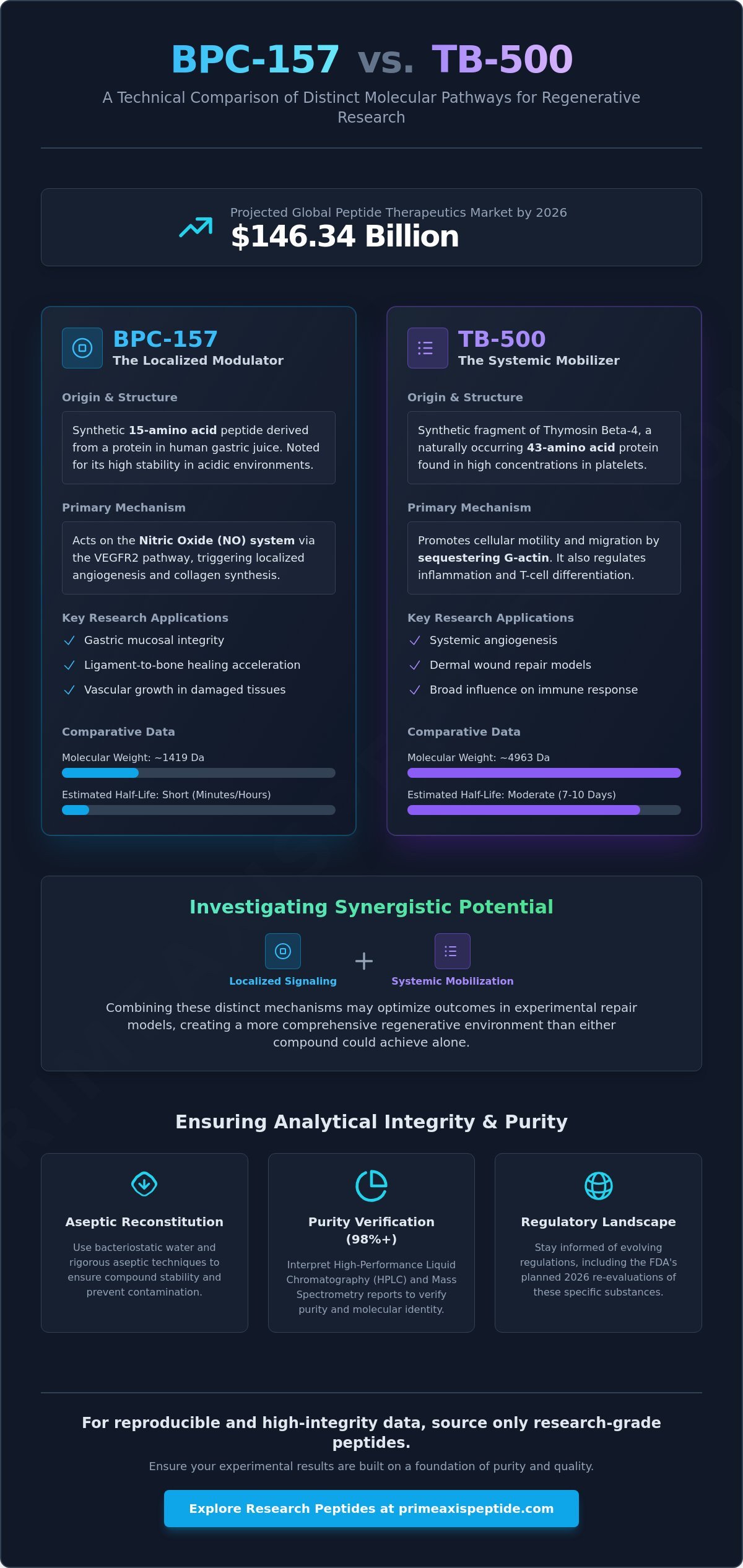
The BPC-157 peptide, or Body Protective Compound 157, is a synthetic pentadecapeptide composed of 15 amino acids. Specifically, its sequence is defined as Gly-Pro-Glu-Pro-Pro-Pro-Gly-Lys-Pro-Ala-Asp-Asp-Ala-Gly-Leu. It’s derived from a larger protein found in human gastric juice, which grants the molecule an inherent resistance to acidic degradation. This stability makes it a unique subject for visceral and musculoskeletal research. In laboratory settings, BPC-157 is frequently utilized to study gastric mucosal integrity and the acceleration of ligament-to-bone healing, where its localized signaling pathways provide a focused area of inquiry.
The Architecture of TB-500
TB-500 represents a synthetic version of the active domain of Thymosin Beta-4, a naturally occurring 43-amino acid peptide found in high concentrations in blood platelets and wound fluid. Unlike the localized nature of gastric-derived sequences, TB-500 operates through a systemic framework. Its primary mechanism involves sequestering G-actin (globular actin), which is a critical process for promoting cellular motility and migration. Researchers focus on the TB-500 research peptide for its potential in systemic angiogenesis and dermal wound repair. Because it’s a smaller, synthetic fragment of the parent molecule, it maintains a high degree of stability while facilitating easier penetration through tissue barriers during in-vitro and in-vivo experimentation.
This distinction is a cornerstone of BPC-157 vs TB-500 research, as it defines the scope of each compound’s experimental application. Comparing these two requires a disciplined approach to their synthetic nature versus their naturally derived sequences. BPC-157 remains a stable, localized pentadecapeptide, while TB-500 mimics a larger, systemic protein. Understanding these structural boundaries is essential for any laboratory protocol aiming for reproducible and high-integrity data in tissue repair models.
Comparative Mechanisms: Angiogenesis vs. Cellular Migration
Evaluating the underlying mechanics of tissue regeneration reveals a sophisticated divergence between these two compounds. In BPC-157 vs TB-500 research, the primary distinction lies in the target of their signaling. BPC-157 acts as a powerful modulator of the Nitric Oxide system, facilitating a stable environment for vascular integrity. Conversely, TB-500 exerts a broader influence on the immune response by regulating T-cell differentiation and inflammation. This difference shifts the research focus from the localized stabilization seen with BPC-157 to the systemic cellular mobilization characteristic of TB-500.
| Parameter | BPC-157 | TB-500 |
|---|---|---|
| Molecular Weight | ~1419 Da | ~4963 Da |
| Estimated Half-life | Short (minutes/hours) | Moderate (7 to 10 days) |
| Primary Pathway | VEGFR2 / NO System | G-Actin / MMPs |
BPC-157 and the VEGFR2 Pathway
BPC-157 initiates repair by triggering early growth response-1 (egr-1) gene expression. This process is critical because it directly correlates with the upregulation of vascular endothelial growth factor (VEGF), which facilitates localized angiogenesis. The perspective provided by USADA on BPC-157 underscores the compound’s potent biological activity; it’s a primary reason the substance is restricted in professional sports. BPC-157 accelerates the synthesis and organization of collagen fibers to enhance structural stability at the site of injury.
TB-500 and Actin Polymerization
TB-500’s primary function is the regulation of cellular migration through its high-affinity binding to G-actin. By sequestering globular actin, it prevents polymerization into F-actin. This maintains a pool of precursors necessary for cell motility. It also modulates matrix metalloproteinases, which are enzymes responsible for remodeling the extracellular matrix. This systemic impact allows for a broader range of action compared to the localized myofibroblast differentiation triggered by gastric-stable peptides. To maintain the integrity of these complex pathways in a lab setting, researchers often utilize high-purity TB-500 vials for precise dosing. Such precision is vital when conducting comparative BPC-157 vs TB-500 research to ensure that signaling differences remain the only variable.
Investigating Synergistic Effects in Experimental Repair Models
Scientists exploring advanced tissue repair protocols often hypothesize that a dual-peptide approach yields superior outcomes compared to monotherapy. This “Complementary Regenerative Pathways” hypothesis suggests that combining localized signaling with systemic mobilization creates a more robust environment for cellular recovery. In BPC-157 vs TB-500 research, this synergy isn’t merely additive; it’s a strategic synchronization of distinct biological events. While BPC-157 establishes the localized vascular infrastructure, TB-500 provides the cellular motility required to populate that infrastructure with repair-active cells.
BPC-157 acts as the site-specific stabilizer. As established in the therapeutic potential and mechanisms of BPC-157, its ability to modulate the vascular endothelial growth factor (VEGF) pathway ensures that the necessary blood supply is present at the injury site. TB-500 then complements this by facilitating the migration of progenitor cells and fibroblasts to that newly vascularized area. Without the systemic mobilization provided by TB-500, the repair site might lack the cellular density required for rapid closure. Without BPC-157, the incoming cells might lack the organized vascular support to survive and function efficiently.
A common objection in experimental design is the potential for signaling saturation. Critics argue that targeting multiple repair pathways might lead to redundancy or metabolic waste. However, since BPC-157 and TB-500 utilize distinct molecular channels-VEGFR2/NO versus G-actin sequestering-there’s no direct competitive inhibition at the receptor level. Instead, laboratory models often observe accelerated fibroblast proliferation, suggesting that these pathways work in parallel rather than in conflict. This lack of competition allows researchers to maximize experimental value without compromising the integrity of either signaling cascade.
Dual-Pathway Signaling in Tendon Research
In musculoskeletal models, particularly tendon-to-bone healing, the synergy is highly visible. BPC-157 is instrumental in the structural organization of collagen fibers, ensuring they align correctly to withstand mechanical stress. TB-500’s role is to act as a chemotactic agent, drawing in the progenitor cells needed to execute that organization. Co-administration protocols must account for the different half-lives of these compounds to maintain consistent plasma concentrations during the critical initial repair window. This coordination is essential for achieving the high-integrity data required in modern BPC-157 vs TB-500 research.
Inflammatory Modulation and Tissue Remodeling
The interaction between these peptides significantly shortens the inflammatory phase. By modulating TGF-beta signaling, the dual-peptide model shifts the environment from acute inflammation to active remodeling more rapidly than monotherapy. This shift is vital in chronic repair models where persistent inflammation often leads to fibrotic tissue rather than functional regeneration. Cumulative data from ligamentous studies indicate that this combined approach results in higher tensile strength, suggesting that the quality of the repaired tissue is fundamentally improved through this multifaceted signaling approach.
Laboratory Protocols: Reconstitution, Stability, and Storage Standards
Maintaining the analytical integrity of BPC-157 vs TB-500 research requires more than just high-purity compounds; it demands strict adherence to preparation and storage protocols. Any deviation in reconstitution or thermal management can lead to peptide degradation, rendering experimental data unreliable and compromising the validity of the study. Investigators must prioritize a disciplined approach to handle these delicate sequences, ensuring that the molecular architecture remains intact from the moment the vial is unsealed to the final application in the laboratory model.
Reconstitution Best Practices
The transition from a lyophilized state to a liquid solution is a critical phase where precision is non-negotiable. Investigators should utilize a vacuum-sealed vial equalization technique to prevent the rapid entry of diluent, which can cause peptide shear stress. The following steps ensure a stable reconstitution:
- Equalize vial pressure by inserting a sterile needle to allow air to enter slowly before introducing the diluent.
- Introduce the diluent, typically research-grade Bacteriostatic Water, by aiming the stream down the side of the glass rather than directly onto the powder.
- Gently swirl the vial until the solution is clear; never shake the vial, as mechanical agitation can disrupt the fragile peptide bonds.
The inclusion of 0.9% benzyl alcohol in bacteriostatic water serves as a critical bacteriostatic agent. This inhibits the proliferation of contaminants during repeated sampling of multi-use vials, which is essential for maintaining an aseptic environment throughout the duration of the study.
Peptide Stability and Cold-Chain Integrity
Thermal management is the cornerstone of long-term peptide preservation. In their lyophilized (freeze-dried) form, these compounds are relatively stable, but they remain sensitive to temperature fluctuations. Validated laboratory standards dictate that for long-term storage, lyophilized vials should be kept between -20°C and -80°C to prevent degradation over several months. Once reconstituted, the stability window narrows significantly, requiring constant refrigeration at 2°C to 8°C. Data suggests that reconstituted BPC-157 and TB-500 can begin to lose potency within 14 to 28 days if not maintained under strict cold-chain conditions. Exposure to ultraviolet radiation causes the rapid cleavage of peptide bonds and irreversible denaturation. Consequently, vials should be stored in light-resistant containers or dark environments to prevent photo-degradation during BPC-157 vs TB-500 research.
Precise concentration calculations are vital for micro-dosing in in-vitro environments. For example, adding 2.0 mL of bacteriostatic water to a 5 mg vial of BPC-157 results in a concentration of 2.5 mg/mL, or 250 mcg per 0.1 mL. Establishing these ratios with accuracy allows for the reproducible results that characterize high-tier industrial research.
Ensuring Analytical Integrity: Sourcing Research-Grade Peptides
The validity of any BPC-157 vs TB-500 research project is fundamentally tethered to the chemical integrity of the subjects. Without rigorous verification, observations of molecular pathways or tissue repair become anecdotal rather than scientific. In a field where micro-dosing and precise signaling are paramount, even minor impurities can introduce confounding variables that compromise months of laboratory work. Achieving reproducible results requires a disciplined commitment to sourcing compounds that meet elite industrial benchmarks for purity and identity.
High-Performance Liquid Chromatography (HPLC) remains the non-negotiable standard for determining the purity of a research peptide. This process separates each component within a sample to ensure that the primary peak represents the intended compound without the presence of residual solvents or truncated sequences. Complementing this, Mass Spectrometry (MS) confirms the molecular identity by measuring the mass-to-charge ratio. This step is vital to ensure the 15-amino acid sequence of BPC-157 or the specific active domain of TB-500 research peptide is exactly what is present in the vial. Non-certified research chemicals often hide “fillers” or salts that aren’t just inert; they can actively interfere with cellular signaling and inflammatory modulation.
The Role of Third-Party Testing
Independent laboratory verification serves as the industry benchmark for researchers who cannot afford the risk of compromised data. A Certificate of Analysis (CoA) for BPC-157 5mg should be transparent and current. It’s essential to identify the difference between “99% purity” and “99% peptide content.” Purity refers to the absence of other chemical species in the HPLC chromatogram. Peptide content, however, accounts for the actual weight of the peptide itself versus residual moisture or counter-ions like acetate or trifluoroacetate (TFA). High-purity standards, typically 98% or higher, are the only acceptable baseline for advanced regenerative science.
Sourcing for Scientific Rigor
The impact of sourcing on experimental reproducibility cannot be overstated. Prime Axis Peptides prioritizes clinical-grade lyophilization to ensure that every vial maintains its structural integrity during transit and storage. This meticulous freeze-drying process creates a stable, porous cake that facilitates rapid, aseptic reconstitution without the risk of peptide shear stress discussed in previous sections. By maintaining procedural transparency and providing comprehensive analytical reports, we empower researchers to focus on their data rather than the reliability of their materials. Precision in the vial is the only way to ensure precision in the results.
Secure high-purity BPC-157 and TB-500 for your research protocols at Prime Axis Peptides. Maintaining these elite standards is our contribution to the advancement of tissue repair science and the integrity of the global research community.
Advancing the Frontiers of Regenerative Science
The distinction between localized gastric-stable signaling and systemic cellular migration defines the contemporary landscape of BPC-157 vs TB-500 research. By mastering the unique molecular pathways of each compound, investigators can develop sophisticated experimental models that exploit synergistic potentials while maintaining precise control over signaling cascades. Success in these high-stakes environments relies on the rigorous application of laboratory protocols and the absolute analytical integrity of the materials used.
Prime Axis Peptides remains committed to supporting your scientific objectives through uncompromising quality control and procedural transparency. Every batch undergoes third-party HPLC and Mass Spectrometry verification to confirm molecular identity and purity standards. Our specialized cold-chain shipping protocols preserve the stability of these strictly research-grade compounds, ensuring they arrive ready for your most meticulous laboratory requirements. We’re honored to provide the reliable foundation your work requires to push the boundaries of tissue repair science.
Explore the full catalog of research-grade peptides at Prime Axis Peptides.
Frequently Asked Questions
Is BPC-157 or TB-500 more effective for systemic tissue repair research?
TB-500 is the superior subject for systemic tissue repair research because of its natural role in cellular motility and its ability to circulate extensively after administration. While BPC-157 provides high experimental value for localized gastric or ligamentous studies, TB-500’s regulation of G-actin allows it to influence repair mechanisms far from the initial site of interest. This systemic reach is a primary differentiator in comparative laboratory models where widespread cellular migration is the focus.
Can BPC-157 and TB-500 be reconstituted in the same vial for laboratory study?
Reconstituting these peptides within the same vial is not a standard protocol in rigorous laboratory environments. Doing so introduces unnecessary variables regarding the stability and solubility of each compound. Maintaining separate vials ensures that researchers can adjust dosing ratios with precision and avoid potential cross-contamination or degradation that could skew the outcomes of BPC-157 vs TB-500 research. Disciplined separation is essential for maintaining analytical integrity.
What is the recommended storage temperature for lyophilized TB-500 5mg?
For long-term preservation, lyophilized TB-500 5mg must be stored in a freezer at -20°C or below. This temperature range effectively halts the kinetic energy of the molecules, preventing the cleavage of peptide bonds. If the research timeline is shorter than four weeks, refrigeration at 2°C to 8°C is acceptable, provided the environment remains dark and free from significant thermal fluctuations. Consistent thermal management is the cornerstone of peptide stability.
How does BPC-157 maintain stability in gastric environments during research?
BPC-157 possesses a unique molecular sequence that mirrors a protective compound found in human gastric juice. This biological origin grants the peptide an extraordinary resistance to the low pH levels and proteolytic enzymes typical of acidic environments. Consequently, it remains stable and bioactive where other peptides would denature, allowing for detailed investigation into mucosal repair and internal tissue stabilization without the need for specialized protective coatings.
What is the typical half-life of TB-500 in an experimental model?
The half-life of TB-500 in experimental models is typically estimated between 7 and 10 days. This extended duration is primarily due to its systemic distribution and its high-affinity binding to globular actin within the extracellular matrix. Such a sustained presence allows for less frequent dosing intervals in long-term studies compared to peptides with rapid clearance rates, providing a stable baseline for longitudinal observation of cellular migration and remodeling.
Why is Bacteriostatic Water preferred over Sterile Water for peptide reconstitution?
Bacteriostatic Water is the industrial standard for peptide reconstitution because its 0.9% benzyl alcohol content inhibits microbial proliferation. Sterile water is free of microorganisms but doesn’t prevent new contaminants from growing once the vial is accessed. Using bacteriostatic water ensures that multi-use vials remain aseptic throughout the research cycle, protecting the chemical integrity of the solution and ensuring that microbial interference doesn’t compromise the study results.
How do I verify the purity of a BPC-157 research peptide?
Verifying the purity of a research peptide requires a comprehensive review of third-party analytical reports. A valid Certificate of Analysis must include High-Performance Liquid Chromatography (HPLC) to confirm that the compound is at least 98% pure. Additionally, Mass Spectrometry (MS) should be utilized to verify that the molecular weight corresponds exactly to the peptide’s theoretical amino acid sequence, ensuring no fillers or truncated fragments are present in the final product.
What are the common markers used to measure the efficacy of these peptides in-vitro?
Investigators utilize several biochemical markers to quantify efficacy, including the upregulation of vascular endothelial growth factor (VEGF) and early growth response-1 (egr-1) gene expression. In BPC-157 vs TB-500 research, the rate of fibroblast migration and the density of collagen fiber organization are also critical metrics. These indicators provide a measurable framework for evaluating how each peptide influences the inflammatory, proliferative, and remodeling phases of tissue repair in controlled environments.